The F4 keyboard shortcut does not work as expected in Microsoft Excel 2013, Excel 2010, or Excel 2007. For example, when you sort a row (row A), and then you press F4 to repeat the action on another row (row B), row B is not sorted. Or, when you copy and paste a cell, and then you press F4, the cell is pasted. Although you can type the dollar signs manually, the F4 key on your keyboard allows you to add both dollar signs with a single keystroke. If you create formulas frequently, this shortcut can save you a lot of time. Watch the video below to learn how to use the F4 shortcut. Excel Shortcuts List for Mac and PC (Searchable) How to Use this Shortcut List: + Indicates to hold the previous key, while pressing the next key. Indicates to tap the previous key, releasing it before pressing the next key. Find the shortcuts list below: # Description. Excel Shortcut on a MAC. The answer is simple! It can be used exactly as F4 is used in Windows. While typing the formula and right after selecting a reference, pressing COMMAND+T multiple times will make Excel cycle through absolute to.
July 01, 2020 - by Bill Jelen
The mighty F4 key should be in your Excel arsenal for two completely different reasons:
- Use F4 to add dollar signs in formula references to make them absolute, mixed, or relative.
- When you are not editing a formula, use F4 to repeat the last command.
Make a Reference Absolute
F4 Key On Mac For Excel
In the following figure, the tax in C2 is B2 times F1.
But when you copy this formula down, none of the sales tax calculations are working. As you copy the formula down the column, the B2 reference automatically changes to B3, B4, and so on. That is what you want. But unfortunately, the reference to the sales tax in F1 is changing as well. That is not what you want.
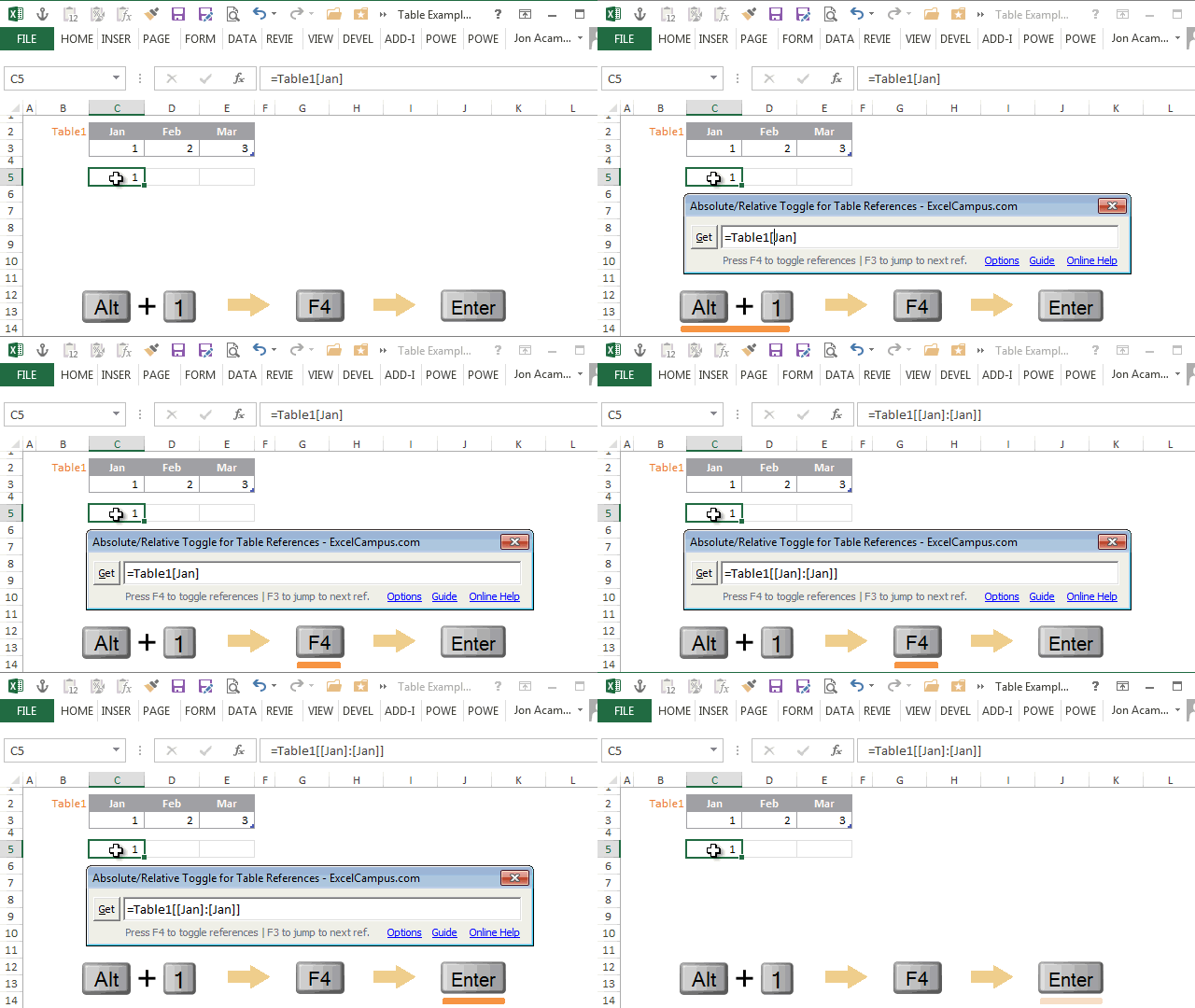
The solution? Edit the original formula and press F4. Two dollar signs are added to the final element of the formula. The $F$1 says that no matter where you copy this formula, that part of the formula always needs to point to F1. This is called an absolute reference. Pressing F4 while the insertion point is touching the F1 reference is a fast way to add both dollar signs.
There are other times when you need only part of the reference to be locked. In the following example, you need to multiply H2 by A3 by C1. The H1 will always point to H1, so you need both dollar signs in $H$1. The A3 will always point back to column A, so you need $A3. The C1 will always point to row 1, so you need C$1.
To enter the above formula, you would press F4 once after clicking on H1, three times after clicking on A3, and twice after clicking on C1. What if you screw up and press F4 too many times? Keep pressing F4: It will toggle back to relative then absolute, then row absolute, then column absolute.
The result? A single formula that can be copied to C3:F12.
Repeat the Last Command
Keyboard shortcuts are great. For example, Alt+E, D, CEnter deletes a column. But even if you are really fast at doing Alt+E, D, CEnter, it can be a pain to do this many times in a row.

After deleting column B, press the Right Arrow key to move to the next column that needs to be deleted. Instead of doing Alt+E, D, CEnter again, simply press F4. This beautiful command repeats the last command that you invoked.
To delete the remaining columns, keep pressing Right Arrow and then F4.
Next, you need to delete a row, so use Alt+E, D, REnter to delete the row.

To keep deleting rows, press the Down Arrow key followed by F4 until all the blank rows are gone.
The F4 trick works for a surprising number of commands. Perhaps you just built a custom format to display numbers in thousands: #,##0,K. If you see a few more cells that need the same format, select the cells and press F4.
Annoyingly, a few commands do not work with F4. For example, going into Field Settings in a pivot table and changing the number format and calculation is one that would be nice to repeat. But it does not work.
Title Photo: Ambitious Creative Co. - Rick Barrett at Unsplash.com
This article is an excerpt from MrExcel 2020 - Seeing Excel Clearly.
Alt key on Mac is indeed exist. And it’s called Option key.
Windows vs Mac—there are so many differences. A lot of our customers have used a PC before and then decide they want to switch to Mac for better performance, nicer design, or for better security. However, they were afraid they would have a hard time getting used to the macOS keyboard. We hear questions like, “How can I close a Window? The Mac keyboard doesn’t have the Alt + F4 shortcut.” We always give them two answers:
Shift F4 In Excel
1. With Parallels Desktop for Mac you have the choice to use the same keyboard shortcuts you had on your PC.
2. If you want to use the Mac keyboard you will experience that the alt key is very different, as we explain in this blog post.
Where is the Alt key on a Mac keyboard?
The PC-keyboard equivalent of Alt on a Mac is called the Option key, and you’ll find the Option Key on your Mac if you go two keys to the left of the spacebar. However, the option key on a Mac keyboard is used in a different way than the alt key on a Windows PC. In terms of functionality, the alt key in Windows is often more comparable with the Command key than with the Option key on a Mac. You might be also familiar with the Ctrl and Alt keys from your PC. On your Mac keyboard, you have Command (⌘ cmd), Control (ctrl), and Option (⌥ alt) keys.
How do Windows shortcuts change on a Mac?
Check out some equivalents of popular Windows alt shortcuts on a Mac, which might be especially helpful for those users who are new to Mac:
| Windows | Mac | |
| Closing a window | Alt-F4 | Command-W |
| Restarting | Control-Alt-Delete | Control-Command-Eject |
| Shutting down | Control-Alt-Delete | Control-Option-Command-Eject |
| Logging out | Control-Alt-Delete | Shift-Command-Q |
| Switch between open apps | Alt + Tab | Command-tab |
| Go back | Alt + Left arrow | Command + Left arrow |
| Go forward | Alt + Right arrow | Command + Right arrow |
| Move up one screen | Alt + Page Up | Command + Page Up |
| Move down one screen | Alt + Page Down | Command + Page Down |
When running Windows on a Mac with Parallels Desktop, is it possible to use Windows shortcuts on a Mac?
If you run Windows on your Mac with Parallels Desktop for Mac, you can configure your keyboard shortcuts the way you want to work, with either macOS or Windows shortcuts. Click here for more information on how to set the different shortcuts.
You can find even more useful Mac shortcuts in the infographic here.
Free Excel For Macbook Pro
Missing your Start Menu and familiar Windows look and feel? You can use Parallels Desktop and have Windows 10 along with your favorite Windows apps on your new Mac.